
Choosing the Right Handrail System for Your Project
Safety codes, material grades, finishes — the right handrail system involves far more than aesthetics. We walk through the key decisions for commercial and residential installations in the UAE.
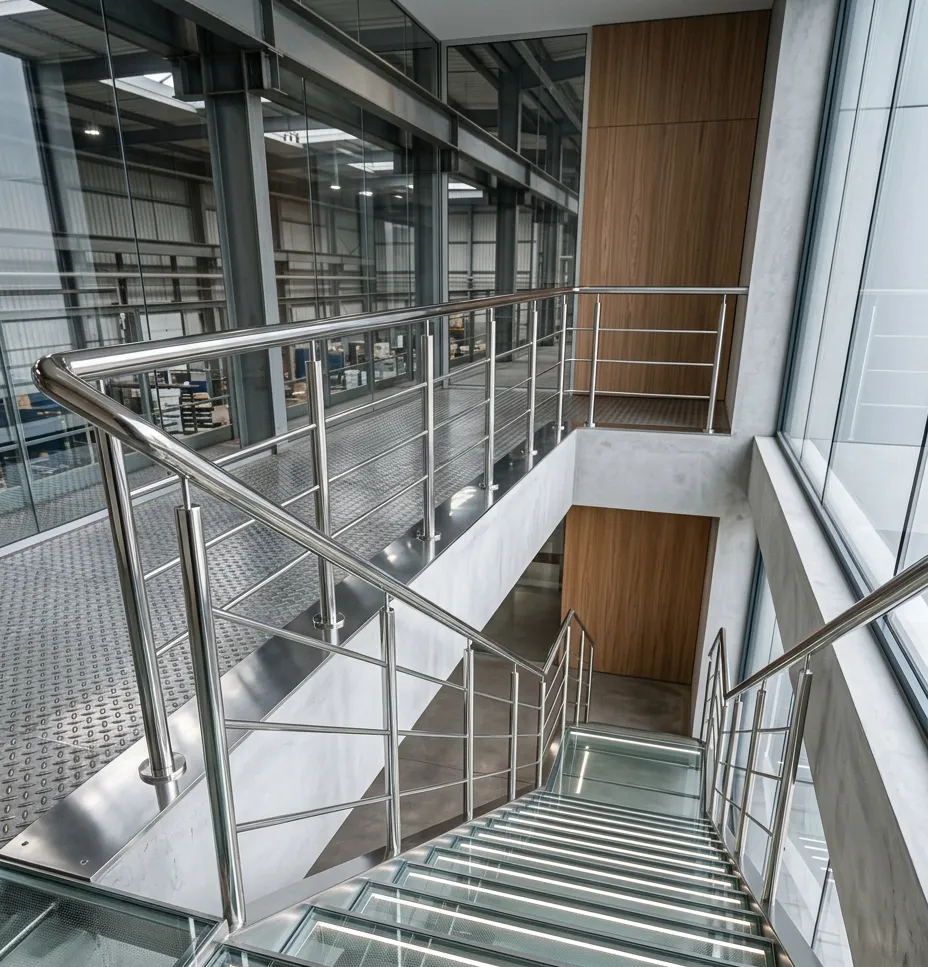
Safety Standards and Compliance
Handrail systems in the UAE must comply with a combination of local building codes and international standards. The UAE Fire and Life Safety Code requires handrails on all staircases, ramps with a gradient exceeding 1:20, and elevated walkways. Key dimensional requirements include a minimum handrail height of 900mm for residential applications and 1,100mm for commercial and public buildings, with intermediate rails spaced to prevent the passage of a 100mm sphere (the 'child safety' requirement).
For projects targeting international certifications (LEED, WELL, or other accessibility standards), handrails must additionally comply with ADA/DDA guidelines, including continuous graspable profiles with a diameter of 32–51mm, extensions beyond the top and bottom of stair runs, and tactile indicators at level changes.
Material Selection: Mild Steel vs. Stainless Steel
The choice between mild steel and stainless steel handrails depends on the installation environment, budget, and aesthetic requirements:
Mild steel handrails are cost-effective and suitable for industrial, warehouse, and back-of-house applications. When powder-coated, they offer good corrosion resistance in sheltered environments. However, they are not recommended for exterior applications in coastal areas without a galvanized base layer.
Stainless steel (Grade 304 for interior, Grade 316 for exterior and coastal) provides superior corrosion resistance, a premium aesthetic, and minimal maintenance requirements. Grade 316 stainless steel is the mandatory specification for any handrail system installed within 5km of the UAE coastline, where salt air corrosion is aggressive.
Finish Options and Their Impact
The finish of a handrail system significantly impacts both appearance and maintenance requirements. For stainless steel, the most common finishes are satin brushed (No. 4 finish, the industry standard for commercial handrails), mirror polished (No. 8 finish, used in high-end lobbies and retail environments), and bead-blasted (a matte finish popular in contemporary architectural applications).
For mild steel, powder coating offers a virtually unlimited color palette with excellent durability. RAL 9005 (jet black) and RAL 7016 (anthracite grey) are the most frequently specified colors in the UAE market, complementing both modern and traditional architectural styles.
Our Fabrication Process
At Covenant House, every handrail project begins with a detailed site survey and CAD drawing. We fabricate complete handrail assemblies in our Sharjah workshop — including all posts, rails, brackets, and end caps — ensuring dimensional accuracy and weld quality before delivery. On-site installation typically requires only bolted connections, minimizing site disruption and ensuring a clean, professional finish. All welded joints are ground smooth and finished to match the surrounding surface, with no visible weld marks on the final product.