
The Complete Guide to Industrial Fencing in the UAE
Security fencing for industrial zones requires more than height — it demands compliance with municipality codes, anti-corrosion treatment, and seamless gate automation. We cover everything you need to know.
Understanding UAE Fencing Regulations
Industrial fencing in the UAE is governed by municipality-specific regulations that vary between Emirates. In Dubai, the Dubai Municipality requires boundary fencing for all industrial plots to be a minimum of 2.4 meters in height, constructed from materials that prevent unauthorized access, and finished in a manner consistent with the surrounding industrial zone aesthetic.
Sharjah Industrial Area regulations similarly mandate perimeter fencing for all commercial and industrial plots, with additional requirements for gate width (minimum 6 meters for vehicle access) and the provision of pedestrian access points. Failure to comply with these regulations can result in fines, construction stop orders, and delays in obtaining completion certificates.
Choosing the Right Fencing System
The three primary fencing systems used in UAE industrial applications are chain link, welded mesh, and ornamental steel:
Chain link fencing is the most cost-effective option for large perimeters. Constructed from galvanized steel wire with a PVC coating for additional corrosion resistance, chain link fencing offers good visibility, adequate security for most applications, and rapid installation. Standard specifications call for 50mm mesh aperture with 3.5mm wire diameter.
Welded mesh panels provide higher rigidity and security than chain link. Constructed from pre-welded steel wire panels mounted on steel posts, welded mesh is more difficult to cut or climb and offers a cleaner, more professional appearance. It is the standard choice for JAFZA, DAFZA, and other free zone industrial areas.
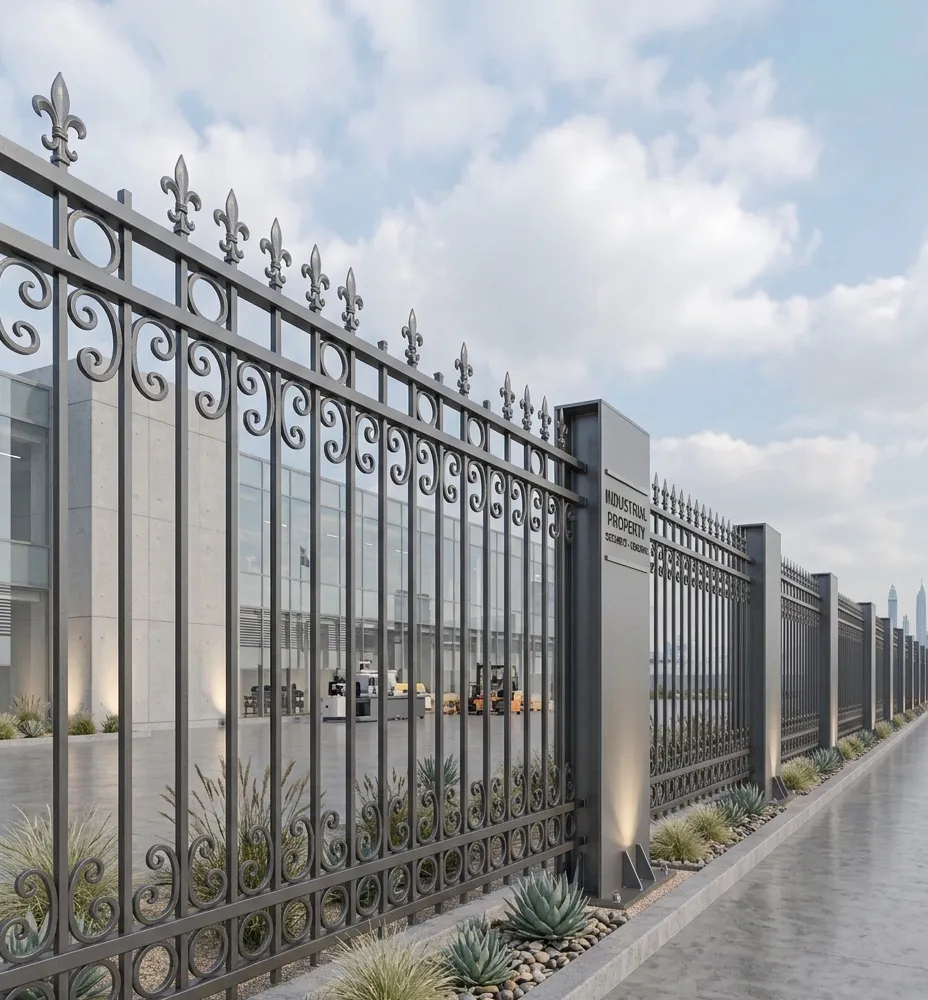
Ornamental steel fencing — fabricated from hollow steel sections with decorative elements — is typically specified for commercial frontages and high-visibility perimeter boundaries where appearance matters alongside security.
Anti-Corrosion Treatment: The Make-or-Break Factor
In the UAE's aggressive coastal environment, untreated steel fencing can begin showing rust within 6–12 months. The industry standard for long-lasting fencing is hot-dip galvanization (HDG) to a minimum coating thickness of 85 microns (per ISO 1461), followed by a polyester powder coat for additional UV and corrosion resistance.
For installations within 5 kilometers of the coastline, we recommend duplex coating systems — HDG followed by a marine-grade epoxy primer and polyurethane topcoat — to achieve service lives of 25+ years without significant maintenance.
Gate Automation and Access Control
A fencing system is only as effective as its access points. Modern industrial gates in the UAE typically incorporate sliding gate operators rated for the gate weight (commonly 500–2000 kg), integrated with access control systems ranging from simple remote control units to RFID card readers and license plate recognition cameras.
At Covenant House, we manage the full scope — from civil works and foundation preparation through to fencing installation, gate fabrication, and automation system integration — ensuring a seamless, fully compliant perimeter security solution.